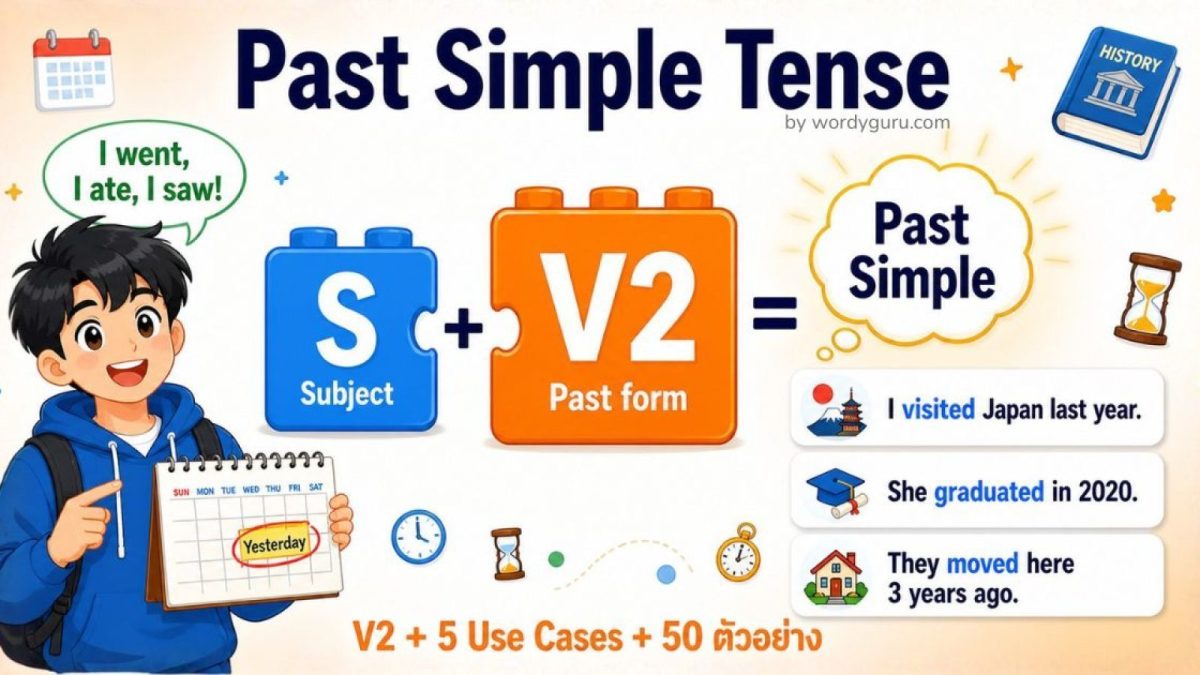
Past Simple Tense (V2) โครงสร้าง การใช้ 5 Use Cases + ตัวอย่าง 50 ประโยค [2026]
สรุปสั้น ๆ — Past Simple Tense คืออะไร
Past Simple Tense คือ tense ที่ใช้พูดถึงเหตุการณ์ที่เกิดขึ้นและจบลงแล้วในอดีต — ใช้ V2 (Past form) ของกริยา
- S + V2 — สำหรับประโยคบอกเล่า (I went / She worked)
- S + did not + V1 — สำหรับปฏิเสธ (didn't go / didn't work)
- Did + S + V1? — สำหรับคำถาม (Did you go? / Did she work?)
ใช้คู่กับ Time Markers ที่ระบุเวลาเฉพาะในอดีต เช่น yesterday, last week, in 2020, 3 days ago — ต่างจาก Present Perfect ที่ไม่ระบุเวลา
- สรุปสั้น ๆ — Past Simple Tense คืออะไร
- A. โครงสร้าง 3 รูปประโยคของ Past Simple
- B. 5 Use Cases ของ Past Simple
- C. 8 Time Markers ที่ใช้กับ Past Simple
- yesterday — เมื่อวาน
- last + week / month / year / Monday — เมื่อสัปดาห์/เดือน/ปี/วันจันทร์ที่แล้ว
- ago — ที่แล้ว / ก่อน
- in + year — ในปี (in 2020, in 1995)
- when + clause — เมื่อ... (ตอนที่...)
- in those days / at that time — สมัยนั้น / ตอนนั้น
- once / one day — ครั้งหนึ่ง / วันหนึ่ง
- this morning / this afternoon (ที่ผ่านไปแล้ว)
- D. การผัน V2 — Regular vs Irregular Verbs
- E. Past Simple vs Past Continuous + Present Perfect
- 5 ข้อผิดพลาดที่พบบ่อยในการใช้ Past Simple
- พร้อมใช้ Past Simple แล้วหรือยัง?
A. โครงสร้าง 3 รูปประโยคของ Past Simple
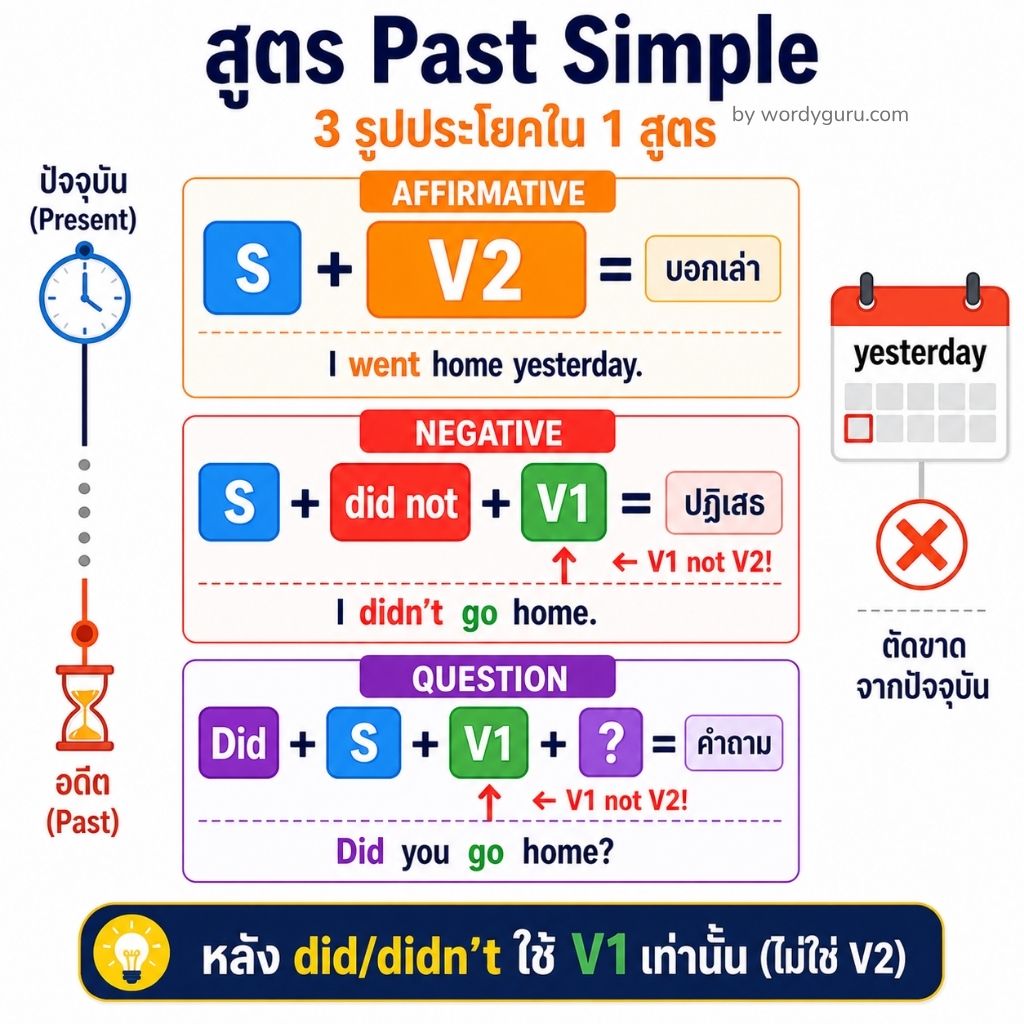
Past Simple มี 3 รูปแบบประโยค — แต่มีจุดสำคัญ: ใช้ did เป็น auxiliary verb สำหรับปฏิเสธและคำถาม (กริยาหลักกลับเป็น V1)
รูปบอกเล่า (Affirmative): S + V2
ใช้บอกว่าเหตุการณ์เกิดขึ้นในอดีต — ใช้ V2 ตรง ๆ ไม่ต้องมี did
โครงสร้างและตัวอย่าง
- S + V2 (Past form) — ทุก subject ใช้ V2 รูปเดียวกันหมด
- "I visited Japan last year." (เคยไปญี่ปุ่นปีที่แล้ว)
- "She worked here in 2020." (ทำงานที่นี่ปี 2020)
- "They went to the cinema yesterday." (ไปดูหนังเมื่อวาน)
- "He ate sushi for dinner." (กินซูชิเป็นมื้อเย็น)
- "We finished the project last week." (เสร็จโปรเจคสัปดาห์ก่อน)
หมายเหตุสำคัญ
Subject ทั้งหมดใช้ V2 รูปเดียวกัน — ไม่เหมือน Present Simple ที่ He/She/It ต้องเติม -s
❌ "He goed home." (ผิด — แต่ใช้ V2 = went)
✅ "He went home." / "They went home." (เหมือนกันหมด)
รูปปฏิเสธ (Negative): S + did not + V1
ใช้บอกว่าเหตุการณ์ไม่ได้เกิดขึ้นในอดีต — ใช้ did not (didn't) + V1 (กลับเป็นรูปฐาน!)
โครงสร้างและรูปย่อ
- did not = didn't — รูปย่อใช้บ่อยในการพูด
- หลัง did/didn't ใช้ V1 (Base form) เสมอ — ไม่ใช่ V2!
- "I didn't go to school yesterday." (ไม่ใช่ didn't went)
- "She didn't see the movie." (ไม่ใช่ didn't saw)
- "We didn't eat dinner together." (ไม่ใช่ didn't ate)
- "They didn't finish on time."
ข้อยกเว้น — verb to be
Verb be (was/were) ไม่ใช้ did — ใช้ was not / were not แทน:
❌ "I didn't be happy."
✅ "I wasn't happy." (was not = wasn't)
✅ "They weren't at home." (were not = weren't)
รูปคำถาม (Question): Did + S + V1?
ใช้ถามเกี่ยวกับเหตุการณ์ในอดีต — ขึ้นต้นด้วย Did + V1
2 ประเภทคำถาม
- Yes/No Questions: Did + S + V1? → "Did you go to school?"
- WH-Questions: WH + did + S + V1? → "What did you do?"
ตัวอย่าง 5 คำถาม
- Did you see her yesterday? (เห็นเธอเมื่อวานไหม?)
- Did they finish the work? (ทำงานเสร็จไหม?)
- What did you eat for lunch? (กินอะไรเที่ยง?)
- Where did she go? (เธอไปไหน?)
- How did he know? (เขารู้ได้ยังไง?)
ข้อยกเว้น — verb to be (อีกครั้ง)
Verb be ไม่ใช้ did — สลับ subject กับ was/were แทน:
❌ "Did you be happy?"
✅ "Were you happy?"
✅ "Was she at the meeting?"
สรุป — โครงสร้าง 3 รูปจำง่าย
บอกเล่า: "I went home." (ไปบ้านแล้ว)
ปฏิเสธ: "I didn't go home." (ไม่ได้ไปบ้าน) — ใช้ V1 หลัง didn't
คำถาม: "Did you go home?" (ไปบ้านไหม?) — ใช้ V1 หลัง did
กฎทอง: ใช้ V2 เฉพาะรูปบอกเล่า — รูปปฏิเสธ/คำถาม กลับเป็น V1
B. 5 Use Cases ของ Past Simple
Past Simple ใช้ใน 5 สถานการณ์ที่ต่างกัน — แต่ทั้งหมดมีจุดร่วมคือเกิดในอดีตและจบไปแล้ว
Use 1: เหตุการณ์ในอดีตที่ระบุเวลาเฉพาะ
Use case ที่ใช้บ่อยที่สุด — มีคำบอกเวลาในอดีตชัดเจน (yesterday, last week, in 2020, ago)
- "I visited grandma last weekend." (ไปหายาย — สุดสัปดาห์ที่แล้ว)
- "She graduated in 2020." (จบการศึกษา — ปี 2020)
- "They moved here 3 years ago." (ย้ายมา — 3 ปีก่อน)
- "We met yesterday." (เจอกัน — เมื่อวาน)
Use 2: เหตุการณ์ที่จบสมบูรณ์ในอดีต (ไม่เกี่ยวกับปัจจุบัน)
เหตุการณ์ที่จบไปแล้ว ตัดขาดจากปัจจุบัน — ผลลัพธ์ไม่เกี่ยวข้องตอนนี้
- "Mozart composed over 600 pieces." (Mozart ตายแล้ว — เขียนเพลงจบแล้ว)
- "The dinosaurs lived millions of years ago." (ไดโนเสาร์สูญพันธุ์)
- "My grandfather built this house." (ปู่ก่อสร้างไว้ — ปู่อาจไม่อยู่แล้ว)
- "Shakespeare wrote Hamlet." (เชคสเปียร์ตายแล้ว)
Use 3: เหตุการณ์ต่อเนื่องเป็นลำดับ (Sequence of past events)
เล่าเรื่องในอดีตที่เกิดต่อ ๆ กัน — ใช้คำเชื่อม first, then, after that, finally
- "I woke up, brushed my teeth, and ate breakfast."
- "She opened the door, stepped inside, and turned on the light."
- "First, we checked in. Then we unpacked. Finally, we went to dinner."
- นิยมใช้ในการเล่านิทาน เล่าเรื่อง เล่าวันของตัวเอง
Use 4: นิสัย / กิจวัตรในอดีต (Past habits)
สิ่งที่เคยทำเป็นประจำในอดีต แต่ไม่ทำแล้ว — มักใช้คู่กับ used to หรือ would
- "When I was a kid, I played football every day."
- "She used to smoke, but she quit." (เคยสูบ แต่เลิกแล้ว)
- "Every summer, we visited our grandparents."
- "He would walk 5 km to school every morning."
- used to + V1 → ใช้ V1 หลัง used to (ไม่ใช่ V2)
Use 5: บอกสถานะในอดีต (Past states with be)
ใช้กับverb to be (was/were) + adjective หรือ noun เพื่อบรรยายสถานะในอดีต
- "I was very happy yesterday." (มีความสุข — เมื่อวาน)
- "She was a teacher in 2010." (เป็นครู — ปี 2010)
- "The weather was terrible last week."
- "They were tired after the trip."
- was = I, He, She, It | were = You, We, They
เคล็ดลับ — แยก Use Cases ของ Past Simple
ทุก Use Case มีจุดร่วม: "จบไปแล้วในอดีต" — ถ้าเหตุการณ์ยังต่อเนื่องถึงปัจจุบันหรือผลลัพธ์ยังเกี่ยวข้อง ให้ใช้ Present Perfect (have/has + V3) แทน
C. 8 Time Markers ที่ใช้กับ Past Simple
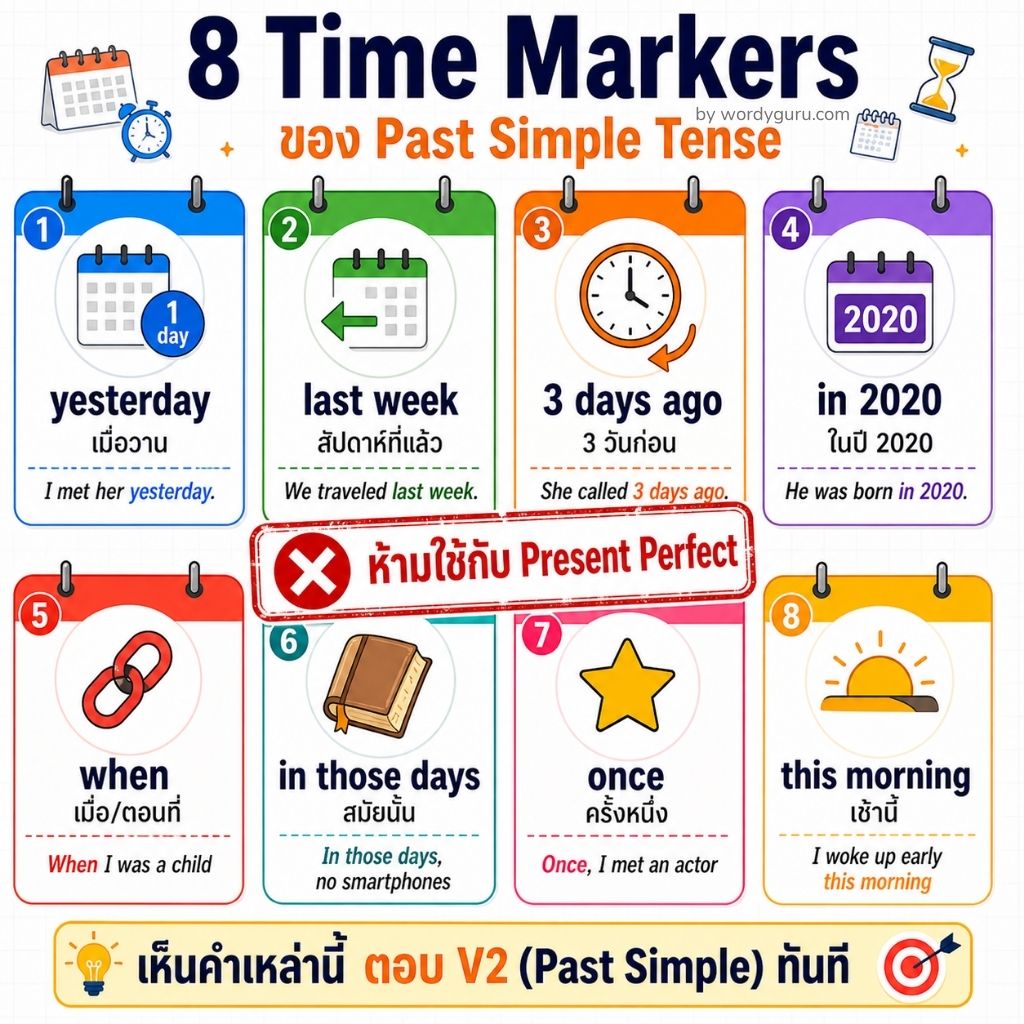
Time Markers คือคำสำคัญที่บอกว่าต้องใช้ Past Simple — เห็นคำเหล่านี้ในประโยค ตอบ Past Simple (V2) ได้ทันที 100%

yesterday — เมื่อวาน
Time marker ที่ใช้บ่อยที่สุด — บอกเหตุการณ์เกิดวันก่อนหน้านี้
ตำแหน่ง: ท้ายประโยค
- "I met her yesterday."
- "She called me yesterday."
- "They arrived yesterday morning."
- "The party ended at midnight yesterday."
last + week / month / year / Monday — เมื่อสัปดาห์/เดือน/ปี/วันจันทร์ที่แล้ว
ใช้บอกช่วงเวลาที่ผ่านพ้นไปก่อนหน้านี้
รูปแบบและตัวอย่าง
- "We traveled to Japan last summer."
- "He quit his job last month."
- "She graduated last year."
- "I saw him last Friday."
- "They moved here last decade."
ago — ที่แล้ว / ก่อน
ใช้บอกระยะเวลาย้อนหลังจากปัจจุบัน — ตำแหน่งหลังจำนวน + หน่วยเวลา
ตำแหน่ง: ท้ายประโยค (หลังจำนวนเวลา)
- "I started learning English 5 years ago."
- "She moved to Bangkok 3 months ago."
- "They got married 10 years ago."
- "He called me an hour ago."
- "The store opened a week ago."
in + year — ในปี (in 2020, in 1995)
ใช้บอกปีที่เหตุการณ์เกิด — ตามด้วยปี ค.ศ. หรือทศวรรษ
ตำแหน่ง: ท้ายประโยค
- "He was born in 1990."
- "The company started in 2015."
- "She finished her degree in 2022."
- "We visited Paris in 2019."
- "The Berlin Wall fell in 1989."
when + clause — เมื่อ... (ตอนที่...)
เชื่อมประโยค 2 เหตุการณ์ในอดีต — บอกตอนที่เกิดเหตุการณ์อะไร
ตำแหน่ง: ต้นหรือกลางประโยค
- "When I was a child, I loved ice cream."
- "She cried when she heard the news."
- "When the phone rang, I answered immediately."
- "He laughed when she told the joke."
in those days / at that time — สมัยนั้น / ตอนนั้น
ใช้พูดถึงยุคสมัยในอดีตหรือช่วงเวลาเฉพาะที่ผ่านไปแล้ว
ตัวอย่าง
- "In those days, people wrote letters by hand."
- "At that time, no one had a smartphone."
- "Travel was very expensive in those days."
- "At that time, she lived in Tokyo."
once / one day — ครั้งหนึ่ง / วันหนึ่ง
ใช้บอกเหตุการณ์ครั้งเดียวในอดีต — มักใช้เริ่มต้นเล่าเรื่อง
ตัวอย่าง
- "Once, I met a famous actor."
- "One day, he discovered a hidden talent."
- "Once upon a time, there lived a king." (เริ่มต้นนิทาน)
- "I tried sushi once and loved it."
this morning / this afternoon (ที่ผ่านไปแล้ว)
ใช้กับช่วงเวลาในวันนี้ที่ผ่านไปแล้ว — ไม่ใช่ตอนนี้
เงื่อนไขสำคัญ
- "I woke up at 6 AM this morning." (พูดตอนบ่าย — เช้าผ่านไปแล้ว)
- "She called me this afternoon." (พูดตอนเย็น)
- "We had a meeting this morning."
- ระวัง: ถ้ายังเป็นช่วงเวลานั้นอยู่ → ใช้ Present Perfect แทน เช่น "I have woken up at 6 this morning" (ยังเป็นเช้าอยู่)
กฎทอง — Time Markers ของ Past Simple
Time markers ของ Past Simple ทั้งหมดมีจุดร่วม: ระบุเวลาเฉพาะในอดีตที่ตัดขาดจากปัจจุบัน
❌ ห้ามใช้กับ Present Perfect เด็ดขาด:
• "I have eaten yesterday." ❌ → "I ate yesterday." ✅
• "She has graduated in 2020." ❌ → "She graduated in 2020." ✅
ดูเทียบ Present Perfect ได้ที่ หน้า Present Perfect Tense
D. การผัน V2 — Regular vs Irregular Verbs
V2 (Past form) แบ่งเป็น 2 กลุ่มใหญ่ — Regular Verbs (เติม -ed ตามกฎ) และ Irregular Verbs (ผันไม่ตามกฎ ต้องท่องจำ)
D1. Regular Verbs — 4 กฎการเติม -ed
กฎที่ 1: V1 ทั่วไป + ed (กฎพื้นฐาน)
เติม -ed ท้ายคำตรง ๆ — ใช้ได้กับกริยาส่วนใหญ่
ตัวอย่าง 10 คำ
- work → worked, play → played, watch → watched
- walk → walked, talk → talked, ask → asked
- cook → cooked, help → helped, learn → learned
- open → opened
กฎที่ 2: V1 ลงท้าย -e → เติม -d อย่างเดียว
ถ้า V1 มี -e อยู่แล้ว เติมแค่ -d (ไม่ต้องเติม -ed ซ้ำ)
ตัวอย่าง 10 คำ
- live → lived, like → liked, love → loved
- move → moved, hope → hoped, smile → smiled
- dance → danced, change → changed, decide → decided
- arrive → arrived
กฎที่ 3: V1 ลงท้าย consonant + y → เปลี่ยน y เป็น i + ed
ถ้า V1 ลงท้าย y ที่หน้าเป็นพยัญชนะ ต้องเปลี่ยน y เป็น i ก่อนเติม -ed
ตัวอย่าง 8 คำ
- study → studied (ไม่ใช่ studyed)
- cry → cried, try → tried, fly → (Irregular: flew)
- carry → carried, marry → married, hurry → hurried
- copy → copied, worry → worried
- ข้อยกเว้น: ถ้าหน้า y เป็นสระ → เติม -ed ตรง ๆ เช่น play → played, enjoy → enjoyed
กฎที่ 4: V1 พยางค์เดียว ลงท้าย vowel + consonant → ซ้ำพยัญชนะ + ed
ถ้า V1 พยางค์เดียว ลงท้ายสระ + พยัญชนะ 1 ตัว ต้องซ้ำพยัญชนะตัวสุดท้าย
ตัวอย่าง 8 คำ
- stop → stopped (ไม่ใช่ stoped)
- plan → planned, ban → banned, scan → scanned
- fit → fitted, hop → hopped, jog → jogged
- chat → chatted, prefer → preferred
- ข้อยกเว้น: ถ้าลงท้าย w, x, y → ไม่ต้องซ้ำ เช่น show → showed, fix → fixed
เคล็ดลับ — การออกเสียง -ed มี 3 แบบ
เสียง /t/: หลังพยัญชนะไร้เสียง (k, p, s, ch, sh, f) — เช่น worked, helped, watched
เสียง /d/: หลังสระและพยัญชนะมีเสียง (b, g, l, m, n, r, v) — เช่น lived, played, opened
เสียง /ɪd/: หลัง t, d เท่านั้น — เช่น wanted, decided, ended
D2. Irregular Verbs — ผันไม่ตามกฎ
Irregular Verbs ใน V2 ต้องท่องจำเป็นพิเศษ — ไม่มีกฎตายตัว แต่จัดเป็น 7 patterns เพื่อจำง่ายขึ้น
| # | V1 | V2 | ความหมาย | Pattern |
|---|---|---|---|---|
| 1 | be | was/were | เป็น/อยู่/คือ | พิเศษ |
| 2 | go | went | ไป | พิเศษ |
| 3 | do | did | ทำ | พิเศษ |
| 4 | have | had | มี | V2=V3 |
| 5 | get | got | ได้/ได้รับ | V2=V3 |
| 6 | make | made | ทำ/สร้าง | V2=V3 |
| 7 | say | said | พูด | V2=V3 |
| 8 | see | saw | เห็น | +n/en |
| 9 | come | came | มา | V1=V3 |
| 10 | take | took | เอา/รับ | +n/en |
| 11 | know | knew | รู้ | ow→ew |
| 12 | think | thought | คิด | V2=V3 |
| 13 | give | gave | ให้ | i→o→en |
| 14 | find | found | พบ | V2=V3 |
| 15 | tell | told | บอก | V2=V3 |
| 16 | feel | felt | รู้สึก | V2=V3 |
| 17 | leave | left | จาก | V2=V3 |
| 18 | write | wrote | เขียน | i→o→en |
| 19 | buy | bought | ซื้อ | V2=V3 |
| 20 | sing | sang | ร้องเพลง | i→a→u |
ดูเพิ่มเติม
20 Irregular V2 ที่ใช้บ่อยนี้เป็นเพียงส่วนหนึ่ง — ถ้าต้องการ:
• รายการครบ 100 คำ + V3 + ตัวอย่าง → หน้า 100 กริยาที่ใช้บ่อย
• Pattern จัดกลุ่มผันคล้ายกัน → หน้า 7 Pattern Irregular Verbs
• รายการ A-Z 1,000+ คำ → หน้า A-Z ทุกตัวอักษร
E. Past Simple vs Past Continuous + Present Perfect
Past Simple มี 2 tense คู่หูที่นักเรียนสับสนบ่อย — Past Continuous (กำลังทำในอดีต) และ Present Perfect (ทำมาแล้วเกี่ยวกับปัจจุบัน)
E1. Past Simple vs Past Continuous
Past Continuous (was/were + V-ing) ใช้บอกเหตุการณ์ที่กำลังดำเนินอยู่ในอดีต — ต่างจาก Past Simple ที่บอกเหตุการณ์จบสมบูรณ์
| เกณฑ์ | Past Simple | Past Continuous |
|---|---|---|
| โครงสร้าง | S + V2 | S + was/were + V-ing |
| ลักษณะการกระทำ | จบสมบูรณ์ | กำลังดำเนิน |
| เน้นที่ | ผลลัพธ์ | กระบวนการ |
| คำที่ใช้คู่ | yesterday, last week, ago | while, when, at 5 PM yesterday |
เปรียบเทียบประโยคจริง
- Past Simple: "I cooked dinner." (ทำเสร็จแล้ว)
- Past Continuous: "I was cooking dinner." (กำลังทำอยู่)
2 เหตุการณ์ขัดจังหวะกัน — ใช้ทั้ง 2 tense
เมื่อมี 2 เหตุการณ์ — เหตุการณ์ที่กำลังเกิดใช้ Past Continuous / เหตุการณ์ที่ขัดจังหวะใช้ Past Simple
- "I was watching TV when the phone rang."
(กำลังดู TV — โทรศัพท์ดัง) - "She was studying when her friend arrived."
(กำลังเรียน — เพื่อนมา) - "It was raining when we left the house."
2 เหตุการณ์เกิดพร้อมกัน — ใช้ Past Continuous ทั้งคู่
เมื่อมี 2 เหตุการณ์ดำเนินไปพร้อมกัน — ใช้ Past Continuous ทั้ง 2 ฝั่ง
- "I was cooking while she was cleaning."
- "They were dancing while we were singing."
E2. Past Simple vs Present Perfect (สรุป)
หัวข้อนี้อธิบายละเอียดในหน้า Present Perfect Tense — ส่วนนี้สรุปสั้น ๆ
| เกณฑ์ | Past Simple | Present Perfect |
|---|---|---|
| โครงสร้าง | V2 | have/has + V3 |
| เวลาเฉพาะ | ระบุชัด (yesterday, ago) | ไม่ระบุชัด |
| เกี่ยวกับปัจจุบัน | จบแล้ว / ตัดขาด | เกี่ยวข้อง / ผลยังอยู่ |
| ตัวอย่าง | I went to Japan last year. | I have been to Japan twice. |
เทคนิคแยก 3 tense ใน 5 วินาที
1. มี time marker เฉพาะ (yesterday, ago, in 2020)? → Past Simple
2. กำลังเกิดในจุดเวลาในอดีต (was/were + V-ing)? → Past Continuous
3. ไม่ระบุเวลา + เกี่ยวกับปัจจุบัน (since, for, just, already)? → Present Perfect
5 ข้อผิดพลาดที่พบบ่อยในการใช้ Past Simple
ผิด: ใช้ V2 หลัง did/didn't
ผิด: I didn't went to school. / Did you saw her?
ถูก: I didn't go to school. / Did you see her?
วิธีจำ: หลัง did/didn't ต้องใช้ V1 (Base form) เสมอ — ห้ามใช้ V2 (did เก็บความหมาย "อดีต" ไว้แล้ว)
ผิด: ใช้ V1 ในประโยคบอกเล่า (ไม่เปลี่ยนเป็น V2)
ผิด: He go home yesterday. / She eat dinner at 7.
ถูก: He went home yesterday. / She ate dinner at 7.
วิธีจำ: ในประโยคบอกเล่า Past Simple ต้องใช้ V2 — ดูคำใบ้เวลา (yesterday, last week) → ใช้ V2 เสมอ
ผิด: ใช้ Present Perfect กับเวลาเฉพาะในอดีต
ผิด: I have eaten breakfast yesterday. / She has graduated in 2020.
ถูก: I ate breakfast yesterday. / She graduated in 2020.
วิธีจำ: เวลาเฉพาะในอดีต (yesterday, ago, in 2020, last week) → ใช้ Past Simple เท่านั้น — ห้ามใช้ Present Perfect
ผิด: ใช้ V2 ผิดรูปกับ Irregular Verbs
ผิด: He goed home. / She eated lunch. / I taked the bus.
ถูก: He went home. / She ate lunch. / I took the bus.
วิธีจำ: Irregular Verbs ผันไม่ตามกฎ — ต้องท่องจำ ใช้ Pattern จัดกลุ่มช่วยจำได้ง่ายขึ้น
ผิด: ใช้ did กับ verb to be
ผิด: Did you be happy? / I didn't be tired.
ถูก: Were you happy? / I wasn't tired.
วิธีจำ: Verb to be (was/were) เป็นข้อยกเว้น — ไม่ใช้ did แต่สลับ subject กับ was/were โดยตรง