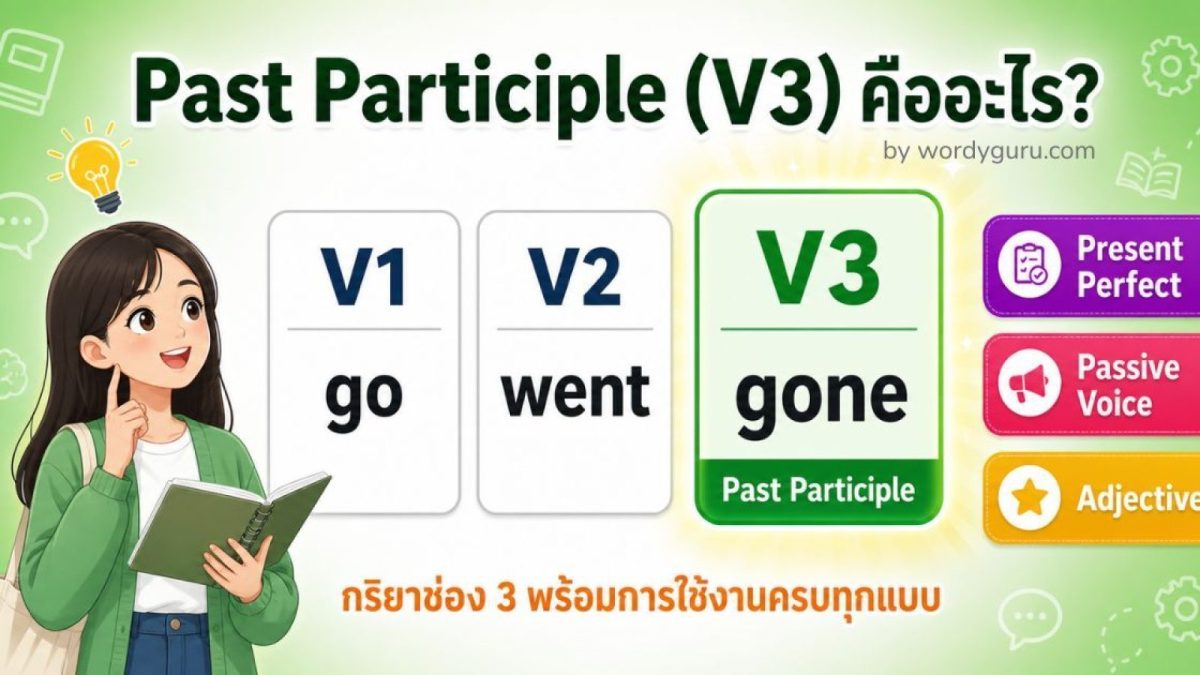
Past Participle (V3) คืออะไร? + 3 การใช้ + ตาราง 30 คำ
สรุปสั้น ๆ — Past Participle (V3) คืออะไร?
Past Participle (V3) คือกริยาช่อง 3 ใช้ใน 3 สถานการณ์หลัก:
- Perfect Tense — have/has/had/will have + V3 (เช่น I have eaten breakfast.)
- Passive Voice — be (is/am/are/was/were/been) + V3 (เช่น The book is read by many.)
- คำคุณศัพท์ (Adjective) — ขยายคำนาม (เช่น a broken window)
V3 มี 2 ประเภท: Regular (เติม -ed ตามกฎ) และ Irregular (~150 คำ ต้องท่องจำ)
V1 / V2 / V3 ต่างกันยังไง?
กริยาในภาษาอังกฤษมี 3 ช่อง (3 รูปแบบ) แต่ละช่องใช้ในบริบทต่างกัน:
| ช่อง | ชื่อทางการ | ใช้ตอนไหน | ตัวอย่าง (กริยา eat) |
|---|---|---|---|
| V1 | Base / Present | Present Simple, Future, Modal | I eat breakfast every day. |
| V2 | Past Simple | Past Simple Tense (อดีต) | I ate breakfast yesterday. |
| V3 | Past Participle | Perfect / Passive / Adjective | I have eaten breakfast. |
💡 จุดต่างสำคัญระหว่าง V2 กับ V3
V2 ใช้ เดี่ยว ๆ ในประโยค Past Simple (เช่น I ate)
V3 ใช้ ร่วมกับคำช่วยเสมอ เช่น have/has/had หรือ be (เช่น I have eaten, The food is eaten)
3 สถานการณ์ที่ต้องใช้ V3
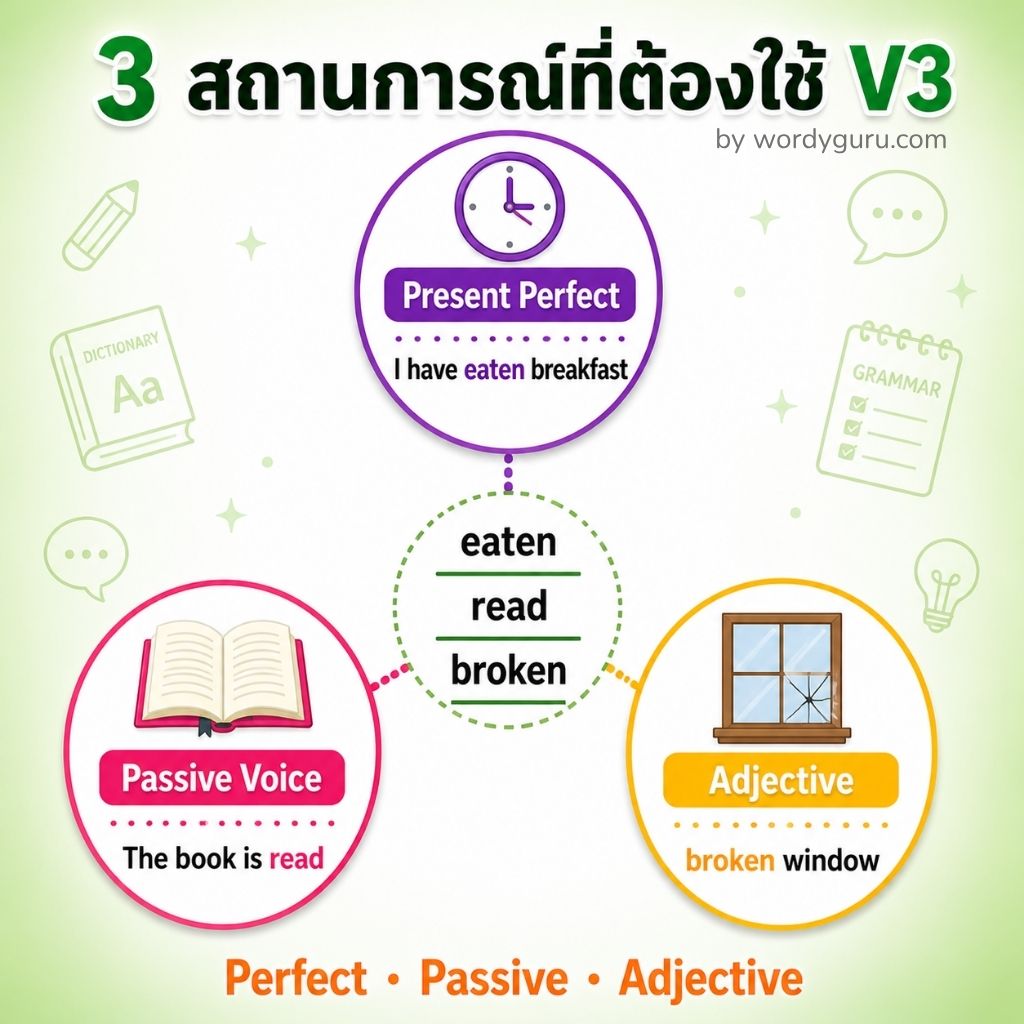
1. ใช้กับ Perfect Tense (have/has/had/will have + V3)
Perfect Tense พูดถึง การกระทำที่เสร็จสมบูรณ์ ก่อนเวลาที่ระบุ — ทุก Perfect Tense ใช้ V3 หลัง have/has/had:
- Present Perfect: have/has + V3 → I have eaten lunch already. (ฉันกินข้าวเที่ยงเสร็จแล้ว)
- Past Perfect: had + V3 → She had finished before I arrived. (เธอทำเสร็จก่อนที่ฉันมาถึง)
- Future Perfect: will have + V3 → They will have completed by tomorrow. (พวกเขาจะทำเสร็จภายในพรุ่งนี้)
📖 อ่านเพิ่ม: Present Perfect Tense + V3 ครบสูตร
2. ใช้กับ Passive Voice (be + V3)
Passive Voice ใช้บอกว่า ประธานถูกกระทำ (ไม่ใช่ผู้กระทำ) โครงสร้างคือ be + V3:
- The book is read by many people. (หนังสือถูกอ่านโดยคนจำนวนมาก)
- The cake was eaten by John. (เค้กถูกกินโดย John)
- The report has been written carefully. (รายงานถูกเขียนอย่างระมัดระวัง)
- The house will be built next year. (บ้านจะถูกสร้างปีหน้า)
📖 อ่านเพิ่ม: Passive Voice ครบทั้ง 9 Tenses
3. ใช้เป็นคำคุณศัพท์ (V3 as Adjective)
V3 หลายคำสามารถใช้ ขยายคำนาม เหมือนคำคุณศัพท์ — สื่อความหมายว่า "ถูก..." หรือ "ที่เสร็จแล้ว":
- a broken window (หน้าต่างที่แตก) — V3 ของ break
- a written agreement (ข้อตกลงที่เขียนเป็นลายลักษณ์อักษร) — V3 ของ write
- a stolen car (รถที่ถูกขโมย) — V3 ของ steal
- a frozen pizza (พิซซ่าแช่แข็ง) — V3 ของ freeze
- my preferred choice (ตัวเลือกที่ฉันชอบ) — V3 ของ prefer
⚠️ ระวัง! V3 vs V-ing เป็น Adjective
V3 = "ถูกกระทำ" (passive sense): a broken window = หน้าต่างที่ถูกทำให้แตก
V-ing = "กำลังกระทำ" (active sense): a breaking news = ข่าวด่วน (ที่กำลังเกิดขึ้น)
โครงสร้าง Tense ที่ใช้ V3 (สรุปครบ)
| Tense / Voice | โครงสร้าง | ตัวอย่าง |
|---|---|---|
| Present Perfect | have/has + V3 | I have eaten lunch. |
| Past Perfect | had + V3 | I had eaten before he arrived. |
| Future Perfect | will have + V3 | I will have eaten by 7 pm. |
| Present Perfect Continuous | have/has been + V-ing | I have been working. (ใช้ V-ing ไม่ใช่ V3) |
| Passive (Present Simple) | is/am/are + V3 | The book is read. |
| Passive (Past Simple) | was/were + V3 | The cake was eaten. |
| Passive (Present Perfect) | has/have been + V3 | The report has been written. |
| Passive (Future) | will be + V3 | The house will be built. |
V3 มี 2 ประเภท: Regular vs Irregular
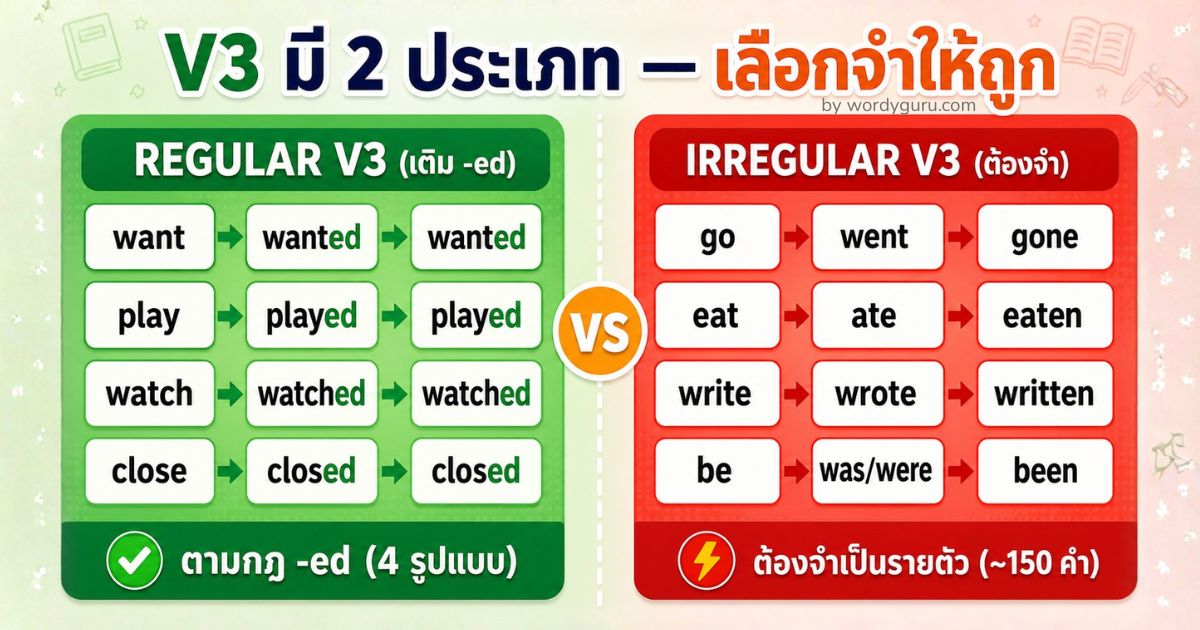
Regular V3 (เติม -ed) — 90% ของกริยาทั้งหมด
Regular Verbs ผัน V3 โดย เติม -ed ที่ V1 ตาม 4 กฎ:
- ทั่วไปเติม -ed: walk → walked, want → wanted, play → played
- ลงท้ายด้วย e เติม -d: live → lived, close → closed, like → liked
- ลงท้ายด้วยพยัญชนะ + y → -ied: study → studied, try → tried, carry → carried
- คำพยางค์เดียว สระเดียว ตามด้วยพยัญชนะเดียว → ซ้ำตัวสุดท้าย + ed: stop → stopped, plan → planned, drop → dropped
📚 ดูครบ 100 คำ: 100 Regular Verbs ที่ใช้บ่อย
Irregular V3 (ต้องจำ) — ~150 คำ ที่ใช้บ่อย
Irregular Verbs ไม่ผันตามกฎ — ต้องท่องจำเป็นรายตัว แต่จัดกลุ่มได้เป็น 7 Pattern หลัก เพื่อช่วยจำ:
| Pattern | ลักษณะ | ตัวอย่าง (V1 → V2 → V3) |
|---|---|---|
| 1. AAA | ทั้ง 3 ช่องเหมือนกัน | cut → cut → cut, put → put → put |
| 2. ABA | V1 = V3 | come → came → come, run → ran → run |
| 3. ABB | V2 = V3 | buy → bought → bought, find → found → found |
| 4. ABC | 3 ช่องต่างกันหมด | go → went → gone, eat → ate → eaten |
| 5. -en ending | V3 ลงท้ายด้วย -en | write → wrote → written, take → took → taken |
| 6. i → a → u | เปลี่ยนสระ i-a-u | swim → swam → swum, ring → rang → rung |
| 7. Same V2 = V3 + sound | V2 V3 เหมือนกัน + เสียงเปลี่ยน | read → read → read, lead → led → led |
🔍 อ่านเพิ่ม: จัดกลุ่ม Irregular Verbs ตาม Pattern (ครบ 7 กลุ่ม)
30 V3 ที่ใช้บ่อยที่สุด พร้อมความหมาย
เริ่มจากการจำ 30 คำนี้ ครอบคลุม ~70% ของบทสนทนาในชีวิตประจำวัน:
| # | V1 | V2 | V3 | ความหมาย |
|---|---|---|---|---|
| 1 | be | was, were | been | เป็น, อยู่, คือ |
| 2 | have | had | had | มี |
| 3 | do | did | done | ทำ |
| 4 | go | went | gone | ไป |
| 5 | say | said | said | พูด |
| 6 | get | got | got, gotten | ได้รับ, ได้ |
| 7 | make | made | made | ทำ, สร้าง |
| 8 | know | knew | known | รู้, รู้จัก |
| 9 | think | thought | thought | คิด |
| 10 | take | took | taken | เอา, นำไป |
| 11 | see | saw | seen | เห็น |
| 12 | come | came | come | มา |
| 13 | give | gave | given | ให้ |
| 14 | find | found | found | พบ, เจอ |
| 15 | tell | told | told | บอก |
| 16 | become | became | become | กลายเป็น |
| 17 | leave | left | left | จากไป, ทิ้งไว้ |
| 18 | feel | felt | felt | รู้สึก |
| 19 | bring | brought | brought | นำมา |
| 20 | begin | began | begun | เริ่ม |
| 21 | write | wrote | written | เขียน |
| 22 | eat | ate | eaten | กิน |
| 23 | run | ran | run | วิ่ง |
| 24 | read | read | read | อ่าน |
| 25 | speak | spoke | spoken | พูด (สนทนา) |
| 26 | drink | drank | drunk | ดื่ม |
| 27 | drive | drove | driven | ขับรถ |
| 28 | break | broke | broken | หัก, แตก |
| 29 | choose | chose | chosen | เลือก |
| 30 | forget | forgot | forgotten | ลืม |
📚 ดู 100 คำใช้บ่อยครบ: 100 กริยา 3 ช่องที่ใช้บ่อยที่สุด
🔍 ค้นหา V3 ของกริยาที่ต้องการ
อยากรู้ V3 ของกริยาตัวใดตัวหนึ่ง? เลือกวิธีที่สะดวกที่สุด:
🎯 3 วิธีค้นหา V3 ของกริยาแต่ละตัว
- 🔍 ค้นหาจากกล่อง Search: เริ่มค้นหาที่นี่ → (พิมพ์ชื่อกริยา เห็นผลทันที)
- 📚 เปิดดูตาราง A-Z: ดูครบ 1,000+ คำ → (กรองตามตัวอักษรได้)
- ⭐ ดู Top 100: 100 คำใช้บ่อยที่สุด →
หรือคลิกตรงไปยังกริยาที่นิยมค้นหา:
- be (เป็น)
- have (มี)
- do (ทำ)
- go (ไป)
- eat (กิน)
- write (เขียน)
- read (อ่าน)
- see (เห็น)
- take (เอา)
- give (ให้)
- make (ทำ)
- get (ได้)
- know (รู้)
- think (คิด)
- come (มา)
- find (พบ)
- tell (บอก)
- leave (จาก)
- break (แตก)
- forget (ลืม)
5 ข้อผิดพลาดที่พบบ่อย (และวิธีแก้)
❌ ผิด 1: ใช้ V2 แทน V3 ใน Perfect Tense
❌ I have ate lunch.
✅ I have eaten lunch. (ใช้ V3 หลัง have/has เสมอ)
❌ ผิด 2: ลืม have/has ก่อน V3
❌ I eaten lunch.
✅ I have eaten lunch. (V3 ใช้เดี่ยวไม่ได้ ต้องมีคำช่วย)
❌ ผิด 3: เติม -ed กับ Irregular Verb
❌ I have goed there.
✅ I have gone there. (go เป็น Irregular V3 = gone)
❌ ผิด 4: สับสน V3 กับ V-ing เป็นคำคุณศัพท์
❌ a breaking window (ความหมาย: หน้าต่างที่กำลังแตก — ผิดบริบท)
✅ a broken window (หน้าต่างที่แตกแล้ว — ใช้ V3)
❌ ผิด 5: ใช้ V3 ใน Past Simple แทน V2
❌ I eaten breakfast yesterday.
✅ I ate breakfast yesterday. (Past Simple ใช้ V2 ไม่ใช่ V3)
📖 อ่านเพิ่ม: Past Simple Tense + V2 ครบ 5 Use Cases เพื่อเข้าใจความต่างของ V2 และ V3