Passive Voice ครบ 9 Tenses + V3 โครงสร้าง การใช้ ตัวอย่าง 30 ประโยค [2026]
สรุปสั้น ๆ — Passive Voice คืออะไร
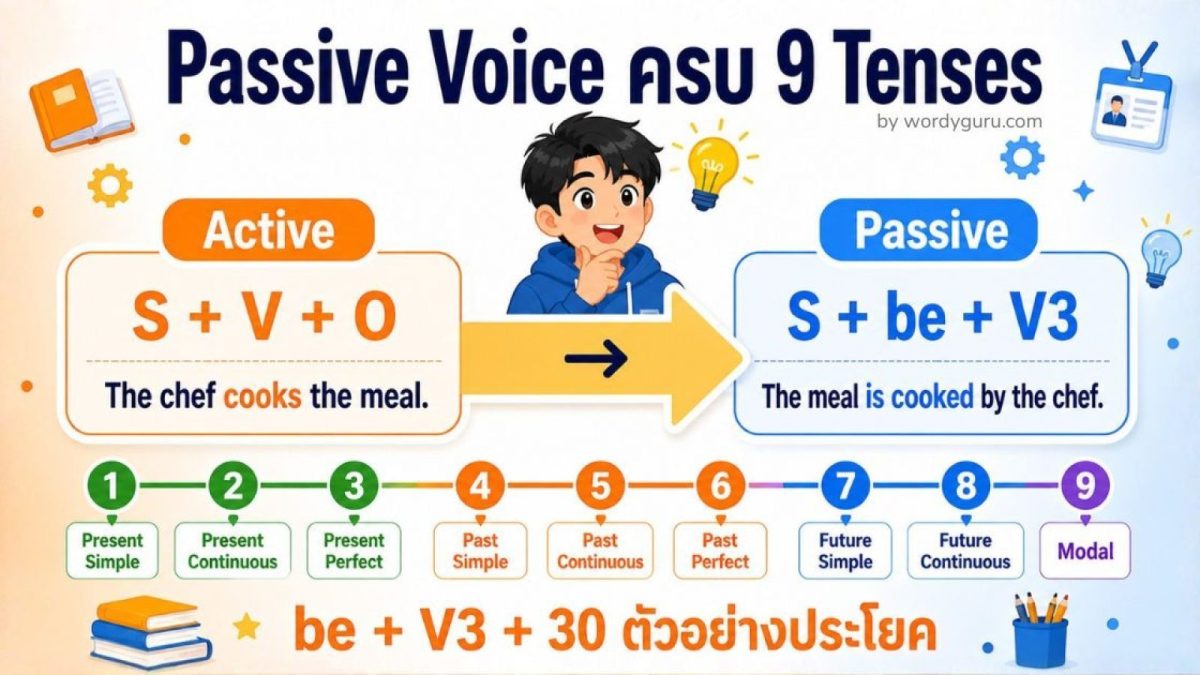
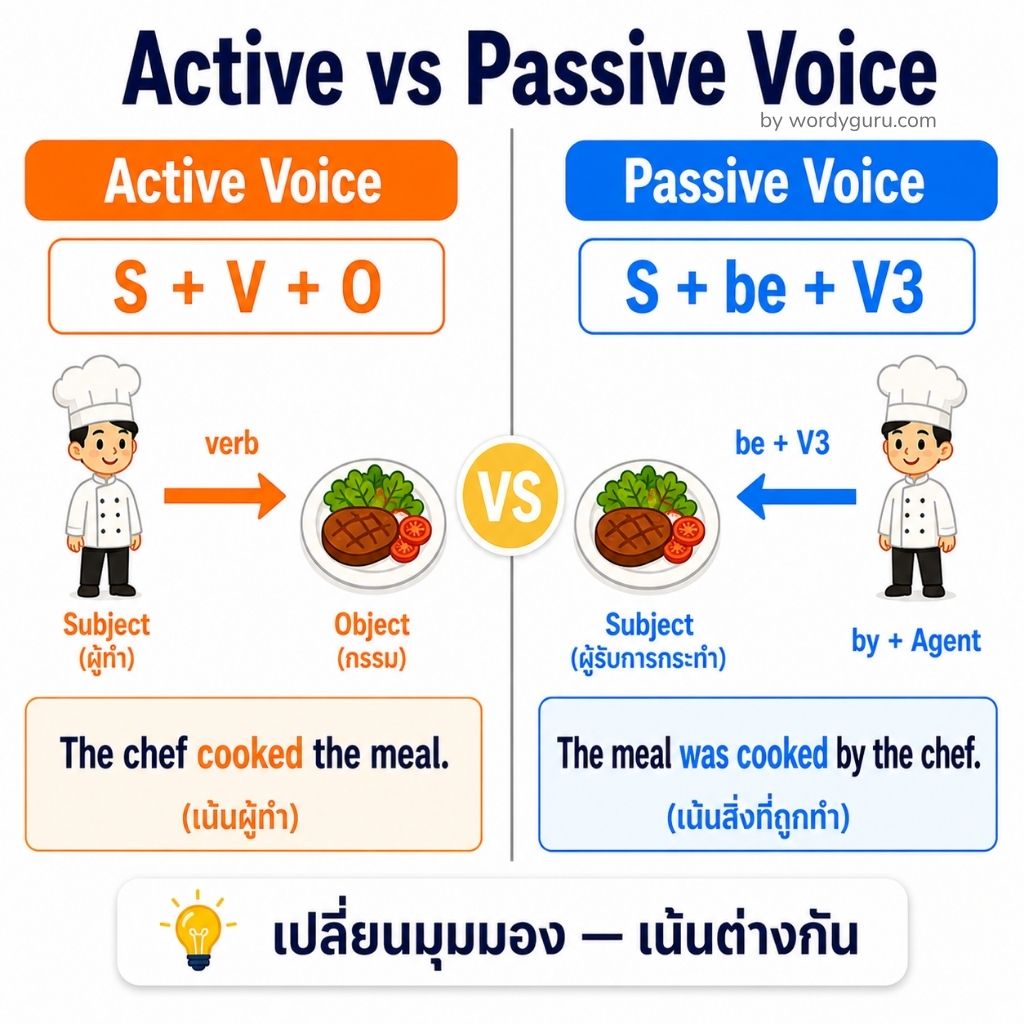
Passive Voice (ประโยคถูกกระทำ) คือประโยคที่ ประธานเป็นผู้รับการกระทำ ไม่ใช่ผู้กระทำ — ใช้เมื่อต้องการเน้นที่สิ่งที่ถูกทำมากกว่าผู้ทำ
- โครงสร้างหลัก: S + be + V3 (+ by + agent)
- Active: The chef cooked the meal. (ใครทำ)
- Passive: The meal was cooked by the chef. (อะไรถูกทำ)
ใช้ได้กับ 9 tenses หลัก โดยเปลี่ยนเฉพาะ verb "be" ตาม tense — V3 ของกริยาหลักไม่เปลี่ยน
- สรุปสั้น ๆ — Passive Voice คืออะไร
- A. 5 เหตุผลที่ต้องใช้ Passive Voice
- B. วิธีแปลง Active → Passive ใน 3 ขั้นตอน
- C. Passive Voice ครบ 9 Tenses — สูตรและตัวอย่าง
- Present Simple Passive: am/is/are + V3
- Present Continuous Passive: am/is/are being + V3
- Present Perfect Passive: have/has been + V3
- Past Simple Passive: was/were + V3
- Past Continuous Passive: was/were being + V3
- Past Perfect Passive: had been + V3
- Future Simple Passive: will be + V3
- Future Perfect Passive: will have been + V3
- Modal Passive: can/should/must/may + be + V3
- D. 30 ตัวอย่างประโยค Passive Voice จากชีวิตจริง
- หมวด 1: ชีวิตประจำวัน (Daily Life) — 5 ประโยค
- หมวด 2: ข่าวและประกาศ (News & Announcements) — 5 ประโยค
- หมวด 3: ที่ทำงาน (Business & Work) — 5 ประโยค
- หมวด 4: ข้อเท็จจริงและประวัติศาสตร์ (Facts & History) — 5 ประโยค
- หมวด 5: การก่อสร้างและการผลิต (Construction & Manufacturing) — 5 ประโยค
- หมวด 6: อาชญากรรมและเหตุการณ์ (Crime & Incidents) — 5 ประโยค
- E. 10 สำนวน Passive ที่ใช้บ่อยในชีวิตประจำวัน
- be born = เกิด
- be made of / be made from = ทำมาจาก
- be known as / be known for = รู้จักในนาม / รู้จักเพราะ
- be supposed to + V1 = ควรจะ / น่าจะ
- be used to + V-ing = เคยชินกับ
- be allowed to + V1 = ได้รับอนุญาตให้
- be required to + V1 = ต้องการ / จำเป็นต้อง
- be expected to + V1 = คาดหวังให้
- be located in / be located at = ตั้งอยู่ที่
- be involved in = เกี่ยวข้องกับ
- 5 ข้อผิดพลาดที่พบบ่อยในการใช้ Passive Voice
- พร้อมใช้ Passive Voice แล้วหรือยัง?
A. 5 เหตุผลที่ต้องใช้ Passive Voice
Passive Voice ไม่ได้ใช้สุ่ม ๆ — มี 5 สถานการณ์ที่ต้องใช้ หรือเหมาะกว่า Active Voice
เหตุผลที่ 1: ไม่รู้ว่าใครเป็นคนทำ
เมื่อไม่รู้ว่าผู้กระทำคือใคร — ใช้ Passive โดยไม่ต้องระบุ by + agent
ตัวอย่าง
- My phone was stolen last night. (โดนขโมย — ไม่รู้ใครขโมย)
- The window has been broken. (กระจกแตก — ไม่รู้ใครทำ)
- This building was built in 1850. (รู้ว่าใครสร้างไม่สำคัญ)
เหตุผลที่ 2: เน้นที่สิ่งที่ถูกทำ ไม่ใช่ผู้ทำ
เมื่อต้องการให้ผู้อ่านโฟกัสที่ "อะไร" มากกว่า "ใคร"
ตัวอย่าง
- The Mona Lisa was painted by Leonardo da Vinci. (เน้นภาพ ไม่เน้นศิลปิน)
- The new policy has been approved. (เน้นนโยบาย ไม่เน้นใครอนุมัติ)
- The contract will be signed tomorrow. (เน้นสัญญา)
เหตุผลที่ 3: ภาษาทางการ / ธุรกิจ / วิทยาศาสตร์
ในเอกสารทางการ ข่าว รายงาน บทความวิทยาศาสตร์ นิยมใช้ Passive เพราะดูเป็นกลางและเป็นทางการกว่า
ตัวอย่าง
- The experiment was conducted over 6 months. (วิทยาศาสตร์)
- Your application has been received. (ธุรกิจ)
- The suspect was arrested yesterday. (ข่าว)
เหตุผลที่ 4: ผู้ทำเป็นที่รู้กันอยู่แล้ว
เมื่อบริบทบอกชัดว่าใครเป็นคนทำ จึงไม่จำเป็นต้องระบุซ้ำ
ตัวอย่าง
- The criminal was sentenced to 5 years. (รู้ว่าศาลเป็นคนตัดสิน)
- Letters are delivered every morning. (รู้ว่าบุรุษไปรษณีย์)
- Tickets can be bought online. (รู้ว่าผู้ใช้ซื้อ)
เหตุผลที่ 5: หลีกเลี่ยงการระบุผู้ทำที่อาจสร้างปัญหา
ใช้เมื่อต้องการหลีกเลี่ยงการกล่าวโทษหรือไม่อยากระบุชื่อคนที่ทำผิด
ตัวอย่าง
- Mistakes were made. (มีคนทำผิด — ไม่บอกใคร)
- The deadline was missed. (เลยกำหนด — ไม่โทษใคร)
- The data was not properly recorded. (ข้อมูลไม่ถูกบันทึก — ไม่บอกใครพลาด)
เคล็ดลับ — เมื่อไหร่ใช้ Active เมื่อไหร่ใช้ Passive
ใช้ Active เมื่อ: ต้องการระบุผู้ทำชัดเจน, เขียนแบบเป็นกันเอง, การพูดในชีวิตประจำวัน
ใช้ Passive เมื่อ: เน้นสิ่งที่ถูกทำ, ภาษาทางการ, ไม่รู้/ไม่อยากบอกผู้ทำ, ข่าว/รายงาน
B. วิธีแปลง Active → Passive ใน 3 ขั้นตอน
การแปลงประโยค Active เป็น Passive มีกฎตายตัว 3 ขั้นตอน — เข้าใจครั้งเดียวใช้ได้กับทุกประโยค
ขั้นที่ 1: เอา "กรรม" ของ Active มาเป็น "ประธาน" ของ Passive
สลับตำแหน่งระหว่าง Subject กับ Object
ตัวอย่าง
- Active: The chef (S) cooked the meal (O).
- Passive: The meal (S ใหม่) ... by the chef (agent).
- กรรม "the meal" → ประธานของ Passive
- ประธาน "the chef" → ย้ายไปท้ายประโยค (หรือตัดออก)
ขั้นที่ 2: ใส่ verb "be" ตาม tense + V3 ของกริยาหลัก
เปลี่ยนเฉพาะ verb "be" ตาม tense ของประโยคเดิม — กริยาหลักเป็น V3 เสมอ
ตัวอย่าง 3 tenses
- Present Simple: The chef cooks the meal. → The meal is cooked by the chef.
- Past Simple: The chef cooked the meal. → The meal was cooked by the chef.
- Present Perfect: The chef has cooked the meal. → The meal has been cooked by the chef.
ขั้นที่ 3: เติม "by + ผู้ทำ" (ถ้าจำเป็น)
ถ้าผู้ทำสำคัญ → เติม by + agent ท้ายประโยค
ถ้าไม่สำคัญ → ตัดทิ้งได้เลย
ใส่ vs ไม่ใส่ by
- ใส่ by (สำคัญ): "The Mona Lisa was painted by Leonardo da Vinci."
- ไม่ใส่ by (ไม่สำคัญ): "My phone was stolen." (ไม่รู้ใครขโมย)
- ไม่ใส่ by (รู้กันอยู่แล้ว): "Tickets are sold here." (รู้ว่าร้านขาย)
สรุปสูตร 3 ขั้นตอน
1. สลับ Object → Subject
2. verb "be" (ตาม tense) + V3
3. เติม "by + agent" ถ้าจำเป็น
ตัวอย่าง: "She writes a book." → "A book is written by her."
C. Passive Voice ครบ 9 Tenses — สูตรและตัวอย่าง
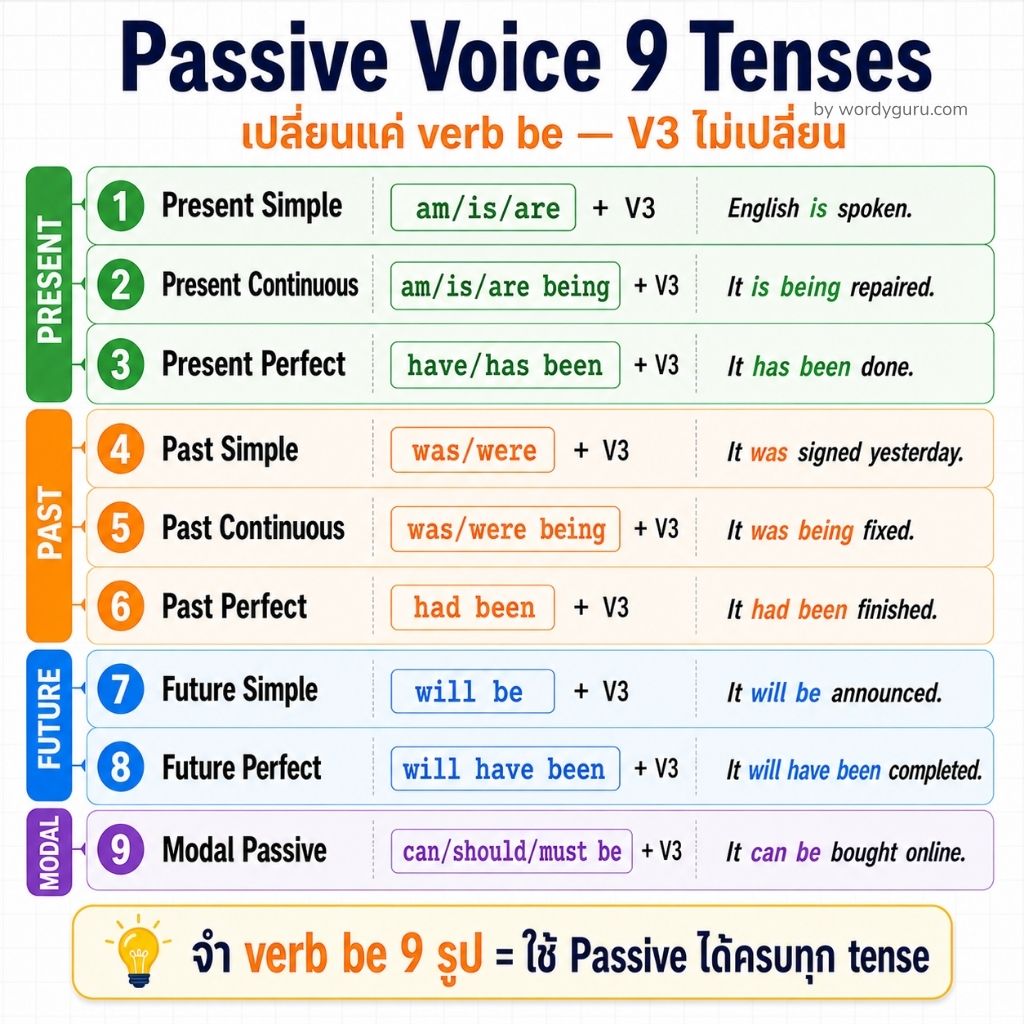
Passive Voice ใช้ได้กับเกือบทุก tense — เปลี่ยนแค่ "verb be" ตาม tense ส่วน V3 ของกริยาหลักไม่เปลี่ยน
Present Simple Passive: am/is/are + V3
ใช้กับเหตุการณ์ที่เป็นความจริง / เกิดเป็นประจำ
โครงสร้างและตัวอย่าง
- I/You/We/They + are + V3 → "The meetings are held every Monday."
- He/She/It + is + V3 → "English is spoken worldwide."
- I + am + V3 → "I am invited to the party."
- ปฏิเสธ: "This rule is not followed here."
- คำถาม: "Are the documents kept here?"
Present Continuous Passive: am/is/are being + V3
ใช้กับเหตุการณ์ที่กำลังเกิดในตอนนี้
โครงสร้างและตัวอย่าง
- S + am/is/are + being + V3
- "The bridge is being repaired." (กำลังถูกซ่อม)
- "Your order is being processed." (กำลังถูกดำเนินการ)
- "New rules are being implemented."
- "My car is being washed right now."
Present Perfect Passive: have/has been + V3
ใช้กับเหตุการณ์ที่ทำเสร็จแล้ว ผลยังคงอยู่ — ออก TOEIC บ่อยมาก
โครงสร้างและตัวอย่าง
- S + have/has + been + V3
- "The report has been submitted." (ส่งแล้ว)
- "Your application has been received."
- "The package has been delivered."
- "All tickets have been sold."
- ใช้คู่กับ: just, already, yet, since, for
Past Simple Passive: was/were + V3
ใช้กับเหตุการณ์ที่จบแล้วในอดีต — ออก TOEIC บ่อย
โครงสร้างและตัวอย่าง
- I/He/She/It + was + V3
- You/We/They + were + V3
- "The contract was signed yesterday."
- "They were promoted last month."
- "This building was built in 1850."
- ใช้กับเวลาเฉพาะ: yesterday, last week, in 2020, ago
Past Continuous Passive: was/were being + V3
ใช้กับเหตุการณ์ที่กำลังเกิดในอดีต
โครงสร้างและตัวอย่าง
- S + was/were + being + V3
- "The road was being repaired when I drove by."
- "The cake was being decorated when she arrived."
- "New employees were being trained all day."
- "My laptop was being fixed at the time."
Past Perfect Passive: had been + V3
ใช้กับเหตุการณ์ที่เกิดก่อนเหตุการณ์อื่นในอดีต
โครงสร้างและตัวอย่าง
- S + had + been + V3
- "The cake had been eaten before I arrived."
- "By 5 PM, the project had been completed."
- "All tickets had been sold by the time we got there."
- ใช้คู่กับ: by the time, before, after, when
Future Simple Passive: will be + V3
ใช้กับเหตุการณ์ที่จะเกิดในอนาคต
โครงสร้างและตัวอย่าง
- S + will be + V3
- "The results will be announced tomorrow."
- "Your order will be shipped within 3 days."
- "The meeting will be held next Monday."
- "You will be informed when ready."
- ใช้กับเวลาในอนาคต: tomorrow, next week, soon
Future Perfect Passive: will have been + V3
ใช้กับเหตุการณ์ที่จะเสร็จก่อนถึงเวลาในอนาคต
โครงสร้างและตัวอย่าง
- S + will have + been + V3
- "The project will have been completed by Friday."
- "All bookings will have been confirmed by tomorrow."
- "The new system will have been installed by next week."
- ใช้คู่กับ: by + เวลาในอนาคต
Modal Passive: can/should/must/may + be + V3
ใช้กับคำกริยาช่วย (modal verbs) — ออก TOEIC บ่อย
โครงสร้างและตัวอย่าง 5 modals
- can be + V3 = สามารถถูก... → "Tickets can be bought online."
- should be + V3 = ควรถูก... → "This form should be completed."
- must be + V3 = ต้องถูก... → "All visitors must be registered."
- may be + V3 = อาจถูก... → "The schedule may be changed."
- have to be + V3 = จำเป็นต้องถูก... → "Mistakes have to be corrected."
เคล็ดลับ — จำสูตรง่าย ๆ
ทุก tense ใน Passive ใช้สูตรเดียวกัน: "verb be" ตาม tense + V3
สิ่งเดียวที่เปลี่ยนคือ verb be (am/is/are/was/were/been/being) — V3 ของกริยาหลักไม่เปลี่ยน
จำ 9 รูป be ให้แม่น = ใช้ Passive ได้ครบทุก tense
D. 30 ตัวอย่างประโยค Passive Voice จากชีวิตจริง
รวม 30 ประโยคจริงที่ใช้ในชีวิตประจำวัน — แบ่งเป็น 6 หมวดตามสถานการณ์
หมวด 1: ชีวิตประจำวัน (Daily Life) — 5 ประโยค
| # | ประโยคอังกฤษ | ความหมายไทย |
|---|---|---|
| 1 | The dishes are washed every day. | จานถูกล้างทุกวัน |
| 2 | My car was repaired yesterday. | รถฉันถูกซ่อมเมื่อวาน |
| 3 | The dinner is being prepared now. | มื้อเย็นกำลังถูกเตรียม |
| 4 | The room has been cleaned. | ห้องถูกทำความสะอาดแล้ว |
| 5 | The laundry will be done tomorrow. | เสื้อผ้าจะถูกซักพรุ่งนี้ |
หมวด 2: ข่าวและประกาศ (News & Announcements) — 5 ประโยค
| # | ประโยคอังกฤษ | ความหมายไทย |
|---|---|---|
| 6 | Three people were injured in the accident. | คน 3 คนได้รับบาดเจ็บจากอุบัติเหตุ |
| 7 | The suspect has been arrested. | ผู้ต้องสงสัยถูกจับแล้ว |
| 8 | A new law was passed last week. | กฎหมายใหม่ถูกผ่านสัปดาห์ที่แล้ว |
| 9 | The match has been postponed due to rain. | การแข่งขันถูกเลื่อนเพราะฝนตก |
| 10 | The winner will be announced tonight. | ผู้ชนะจะถูกประกาศคืนนี้ |
หมวด 3: ที่ทำงาน (Business & Work) — 5 ประโยค
| # | ประโยคอังกฤษ | ความหมายไทย |
|---|---|---|
| 11 | The report was submitted on time. | รายงานถูกส่งทันเวลา |
| 12 | Your order has been processed. | คำสั่งซื้อถูกดำเนินการแล้ว |
| 13 | The contract will be signed tomorrow. | สัญญาจะถูกเซ็นพรุ่งนี้ |
| 14 | All applications must be reviewed. | ใบสมัครทุกใบต้องถูกพิจารณา |
| 15 | Employees are required to wear ID badges. | พนักงานถูกบังคับให้ใส่บัตร |
หมวด 4: ข้อเท็จจริงและประวัติศาสตร์ (Facts & History) — 5 ประโยค
| # | ประโยคอังกฤษ | ความหมายไทย |
|---|---|---|
| 16 | The Mona Lisa was painted by da Vinci. | โมนาลิซ่าถูกวาดโดยดา วินชี่ |
| 17 | America was discovered in 1492. | อเมริกาถูกค้นพบในปี 1492 |
| 18 | English is spoken in over 60 countries. | ภาษาอังกฤษถูกใช้ในกว่า 60 ประเทศ |
| 19 | The light bulb was invented by Edison. | หลอดไฟถูกประดิษฐ์โดยเอดิสัน |
| 20 | Penicillin was discovered in 1928. | เพนิซิลลินถูกค้นพบปี 1928 |
หมวด 5: การก่อสร้างและการผลิต (Construction & Manufacturing) — 5 ประโยค
| # | ประโยคอังกฤษ | ความหมายไทย |
|---|---|---|
| 21 | This bridge was built in 1995. | สะพานนี้ถูกสร้างปี 1995 |
| 22 | iPhones are made in China. | iPhone ถูกผลิตในจีน |
| 23 | The new mall is being constructed. | ห้างใหม่กำลังถูกก่อสร้าง |
| 24 | The road has been resurfaced. | ถนนถูกปูใหม่แล้ว |
| 25 | The factory will be expanded next year. | โรงงานจะถูกขยายปีหน้า |
หมวด 6: อาชญากรรมและเหตุการณ์ (Crime & Incidents) — 5 ประโยค
| # | ประโยคอังกฤษ | ความหมายไทย |
|---|---|---|
| 26 | My phone was stolen last night. | โทรศัพท์ฉันถูกขโมยเมื่อคืน |
| 27 | The window has been broken. | หน้าต่างถูกทำแตก |
| 28 | Two cars were damaged in the storm. | รถ 2 คันถูกพายุทำเสียหาย |
| 29 | The thief was caught by police. | ขโมยถูกจับโดยตำรวจ |
| 30 | Important documents have been lost. | เอกสารสำคัญถูกทำหาย |
เคล็ดลับฝึก 30 ประโยคให้ใช้คล่อง
1. เริ่มจากหมวดที่เกี่ยวข้องกับชีวิต → ฝึก 5 ประโยคต่อวัน
2. ลองแปลงประโยค Active ในชีวิตประจำวันเป็น Passive
3. สังเกต Passive ในข่าว BBC, CNN — เห็นได้ทุกย่อหน้า
4. ใช้คู่กับ 100 V3 ที่ใช้บ่อย → ขยายคลังคำได้เร็ว
5. ทดสอบความแม่นที่ Worksheet Level 4 (Passive Voice เน้น)
E. 10 สำนวน Passive ที่ใช้บ่อยในชีวิตประจำวัน
บางสำนวน Passive ใช้บ่อยจนกลายเป็นวลีตายตัว — จำได้แล้วใช้ได้เลย ไม่ต้องคิดผัน
be born = เกิด
ใช้บอกการเกิด — มักใช้ Past Simple Passive (was/were born)
ตัวอย่าง
- I was born in 1990.
- She was born in Bangkok.
- The twins were born on the same day.
be made of / be made from = ทำมาจาก
made of = วัสดุยังเห็นรูปเดิม | made from = วัสดุเปลี่ยนรูป
ตัวอย่าง
- The table is made of wood. (ยังเห็นเป็นไม้)
- Wine is made from grapes. (เปลี่ยนรูปแล้ว)
- This bag is made of leather.
- Bread is made from wheat.
be known as / be known for = รู้จักในนาม / รู้จักเพราะ
known as = เรียกว่า | known for = มีชื่อเสียงเรื่อง
ตัวอย่าง
- Bangkok is known as the City of Angels.
- Thailand is known for its food.
- He is known as "The King of Pop".
- She is known for her kindness.
be supposed to + V1 = ควรจะ / น่าจะ
ใช้บอกหน้าที่ / ความคาดหวัง
ตัวอย่าง
- You are supposed to be here at 9 AM.
- I am supposed to finish this today.
- The meeting was supposed to start at 2 PM.
- It is supposed to rain tomorrow.
be used to + V-ing = เคยชินกับ
ใช้บอกความเคยชิน / คุ้นเคย — ตามด้วย noun หรือ V-ing
ตัวอย่าง
- I am used to spicy food.
- She is used to waking up early.
- We are used to the noise here.
- He is not used to driving at night.
be allowed to + V1 = ได้รับอนุญาตให้
ใช้บอกการได้รับอนุญาต / สิทธิ์
ตัวอย่าง
- Children are not allowed to enter.
- Visitors are allowed to take photos.
- You are allowed to bring one bag.
- Smoking is not allowed here.
be required to + V1 = ต้องการ / จำเป็นต้อง
ใช้บอกข้อบังคับ / กฎ — ออก TOEIC บ่อย
ตัวอย่าง
- All employees are required to attend.
- Students are required to wear uniforms.
- You are required to show ID.
- Passport is required for check-in.
be expected to + V1 = คาดหวังให้
ใช้บอกความคาดหวัง — ออก TOEIC บ่อย
ตัวอย่าง
- Sales are expected to increase next quarter.
- The CEO is expected to retire soon.
- We are expected to meet the deadline.
- The project is expected to finish by June.
be located in / be located at = ตั้งอยู่ที่
ใช้บอกตำแหน่งสถานที่
ตัวอย่าง
- The hotel is located in downtown.
- The store is located at 123 Main Street.
- Our office is located on the 5th floor.
- The university is located near the airport.
be involved in = เกี่ยวข้องกับ
ใช้บอกการมีส่วนร่วม / เกี่ยวข้อง
ตัวอย่าง
- He was involved in the accident.
- I am involved in the new project.
- Many people were involved in the protest.
- She is not involved in the decision.
เคล็ดลับ — สำนวน Passive ที่ออก TOEIC บ่อยที่สุด
3 สำนวนที่ต้องจำ สำหรับ TOEIC: be required to, be expected to, be allowed to — ออกข้อสอบประมาณ 5-7 ข้อต่อชุด
5 ข้อผิดพลาดที่พบบ่อยในการใช้ Passive Voice
ผิด: ใช้ V1 หรือ V2 หลัง be แทน V3
ผิด: The report was submit yesterday. / The report was submit yesterday.
ถูก: The report was submitted yesterday. (V3 = submitted)
วิธีจำ: หลัง be (am/is/are/was/were/been/being) ต้องเป็น V3 เสมอใน Passive
ผิด: ลืม "be" verb ในประโยค Passive
ผิด: The cake eaten by the children.
ถูก: The cake was eaten by the children.
วิธีจำ: Passive ต้องมี be + V3 เสมอ — ขาด be ไม่ได้
ผิด: ใช้ "be" ผิด tense
ผิด: The contract is signed yesterday.
ถูก: The contract was signed yesterday. (yesterday = อดีต ใช้ was)
วิธีจำ: เลือก verb be ตาม tense — yesterday/last week → was/were | now → am/is/are
ผิด: ใส่ "by + agent" เกินจำเป็น
เกินไป: My phone was stolen by someone.
เหมาะ: My phone was stolen. (ไม่ต้องใส่ "by someone" เพราะรู้อยู่แล้วว่าโดนคน)
วิธีจำ: ใส่ by + agent เฉพาะเมื่อผู้ทำสำคัญหรือระบุชื่อชัด เช่น by da Vinci, by the company
ผิด: ใช้ Passive กับ Intransitive Verbs
ผิด: An accident was happened. / I was arrived at 5 PM.
ถูก: An accident happened. / I arrived at 5 PM.
วิธีจำ: กริยาที่ไม่มีกรรม (intransitive) ทำ Passive ไม่ได้ — เช่น happen, arrive, occur, exist, die, sleep, fall, come, go